


Around 1.7 million people in the UK have Chronic Obstructive Pulmonary Disorder (COPD). But many others – at least 600,000 – are thought to have COPD unknowingly.
COPD is the name for a group of lung conditions that cause breathing problems. With COPD, your lungs become inflamed and damaged. This damage is mostly caused by breathing in something harmful, like cigarette smoke, dust or air pollution.
There are many reasons why so many people with COPD remain undiagnosed. Two of the main risk factors for COPD are smoking and deprivation. This means some people feel there is a stigma attached to the condition.
What’s the impact of late diagnosis?
Diagnosing COPD is also not straightforward. The tool used to diagnose COPD is a breathing test called spirometry. Spirometry only shows abnormal results when there is already significant damage in the lungs. It is also mainly available in hospitals or specialist centres, rather than GPs. COPD is often well advanced before someone has a spirometry test to diagnose the condition.
This creates a vicious cycle, according to Dr Samantha Walker, Director of Research and Innovation at the charity Asthma + Lung UK. “For research to successfully find new treatments to prevent or reverse damage, we need people to get involved who are at an early stage of COPD,” she says. “But people aren’t diagnosed early enough and without more people getting that early diagnosis, they suffer and research suffers as well.
“If people are undiagnosed or diagnosed late, then it becomes impossible to prevent ongoing damage to the lungs. Although there’s no cure for COPD, early diagnosis means people could make lifestyle choices to reduce lung damage, like giving up smoking and doing structured exercise (called, offputtingly, pulmonary rehabilitation). They could benefit from treatments to reduce symptoms and keep their lungs healthy for longer. At the moment, too many people are losing that opportunity.”
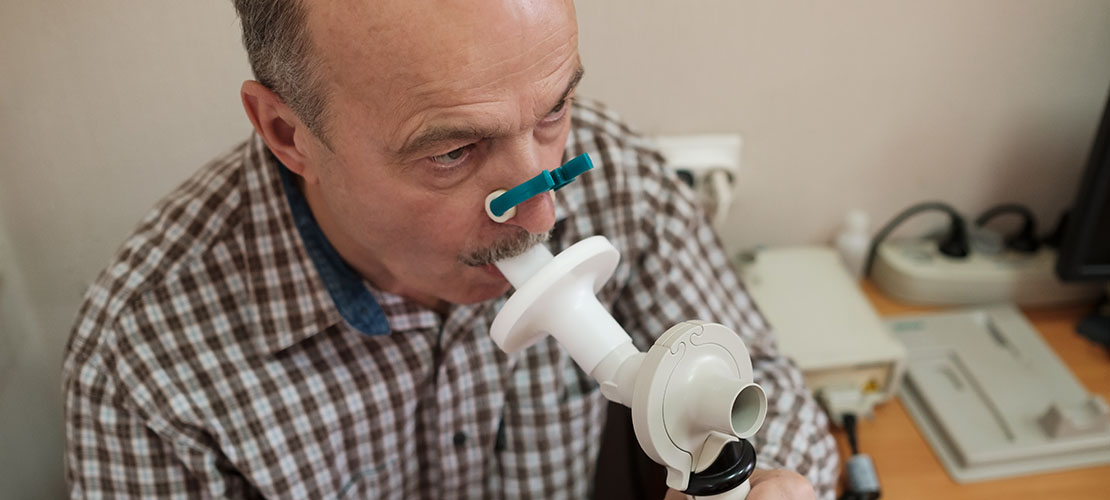
Researchers at the University of Oxford are developing a new way to diagnose COPD at an earlier stage of the condition. This is a new type of analyser that can detect early, subtle changes in the lung where COPD first begins. A trial, funded by Asthma + Lung UK, is now testing this analyser on long-term smokers who are at higher risk of COPD, to see if it can successfully diagnose the condition at an early stage.
Who is affected most by COPD?
Like many health conditions, COPD doesn’t affect all people equally. Women are more likely than men to die from lung conditions like COPD. Researchers believe this is due to sex hormones, including oestrogen. One study, also funded by Asthma + Lung UK, is looking at the effect that oestrogen has on the lungs in women and men. The researchers are comparing younger women with older women who have naturally lower levels of oestrogen, due to the menopause.
There is no cure for COPD, but there are treatments which can help make the symptoms, such as breathlessness, less severe. A recent study, funded by a partnership between NIHR and the UKRI Medical Research Council, looked at whether increasing nitrates in the diet can improve levels of physical activity in people with COPD who need to use oxygen. Nitrates, which are found in leafy green vegetables and beetroot, can help your blood vessels work better to transport oxygen to your muscles. The researchers gave people with COPD a beetroot drink for 3 months and compared them to others who had a similar drink, but with the nitrates removed. The study recently completed and the researchers are now analysing their results.
Can we prevent COPD flare-ups?
People with COPD often experience sudden flare-ups of the condition which means worsening symptoms and more difficulty breathing. Around 750,000 people are admitted to hospital in the UK with a COPD flare-up each year. Even with treatment, these flare-ups can be fatal. Around 30,000 people in the UK die each year in hospital following a COPD flare-up.
Lots of research is looking at how to prevent these flare-ups. There are several small studies showing that the diabetes drug metformin may help. Asthma + Lung UK are funding research using statistical analysis to examine health records from hospitals and GPs. By looking at the records of hundreds of thousands of patients, they hope to see if there is a link between COPD patients being prescribed metformin and having fewer flare-ups.
Preventing flare-ups is one of three key COPD challenges that research needs to address, according to Asthma + Lung UK. The other two are early diagnosis and developing new treatments that can impact the condition itself, not just the symptoms.
“We need to fully understand what’s happening in the lungs to cause COPD. Then we can find ways to prevent or reverse it. For example, why do some smokers get COPD and others not? There are many opportunities for research into COPD that could make a real difference to the lives of millions in the UK.”
- Dr Samantha Walker, Asthma + Lung UK
Join a COPD research study
- The Essential study – looking at the role of oestrogen in COPD
- Creating cellular models of COPD to test new treatments
- Testing the long-term safety in COPD of astegolimab, a monoclonal antibody that is thought to reduce flare-ups
- Assessing a way to reduce readmissions to hospital after discharge following a flare-up
- Testing a medical device that could detect a flare-up before a person knows they are unwell
- The OPACE trial – assessing how best to use the antibiotic azithromycin to prevent flare-ups in COPD
Use our study search tool to find a study that interests you.
How you can get involved with research
Sign up to Be Part of Research to be contacted about health and care studies that match your interests. Or check out our full list of studies to see if one is right for you.
And if taking part in a study doesn’t feel right at the moment there are other ways to get involved in research.