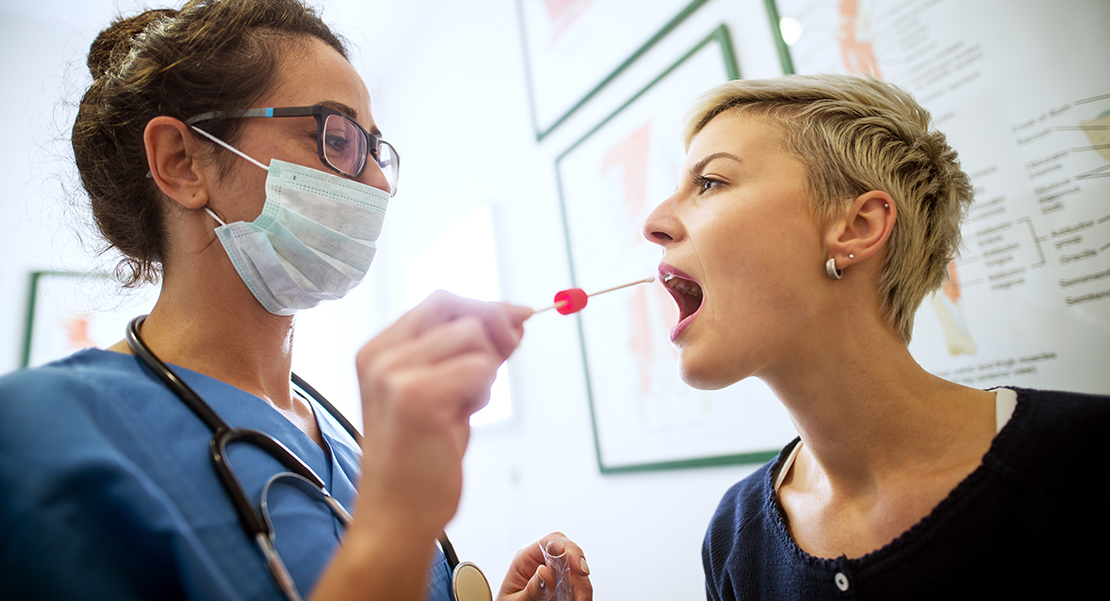


Nearly everyone experiences some form of acne in their lifetime. It can range from a few spots on the face, neck, back or chest to a more severe problem with painful lumps under the skin. Acne is most common in teenagers and younger adults, but 3% of adults will experience acne over the age of 35. 
The main treatments for acne have stayed much the same for 30 years, but research is starting to change that. Dr Beibei Du-Harpur is a dermatologist at Guy’s and St Thomas’ Hospital in London and an NIHR Academic Clinical Lecturer with St John's Institute of Dermatology at Kings College London. Beibei talks to us about how research is helping to shatter some of the myths around acne, understand its causes and look for new treatments.
What is the most common myth around acne?
The number one myth around acne is that it’s linked to hygiene or random bacteria that you come into contact with. That’s completely false. If you have acne and people are saying you’re not washing your face enough, or you’re touching your face too much – they’re wrong.
Myths around acne can be damaging. They can increase people’s mental distress by making them feel responsible for the condition. Research has also found that they lead to people not following their treatment properly.
What has research taught us about the causes of acne?
There are still many aspects of acne that we don’t fully understand, but research has taught us a lot over the last ten years.
We know that acne is associated with specific bacteria called Cutibacterium acnes (C. acnes) on the skin which everybody has. In skin that’s prone to acne, scientists have found that certain strains of C. acnes become unbalanced and cause inflammation.
There’s also a genetic predisposition for acne. In a study led by geneticist Professor Michael Simpson, we’ve analysed the DNA of nearly 70,000 individuals with acne, and found 165 areas of the human genome linked to getting acne. Many of these genes programme how cells form and divide within the skin. So it’s likely that how your skin regenerates can make you more likely to develop the condition.
Hormones are another factor. Acne develops in structures in our skin called pilosebaceous units, which consist of sebaceous (oil) glands attached to hair follicles. These play an important role in healthy skin function, but are sensitive to hormones like testosterone and oestrogen. During adolescence, the most common time to get acne, these sex hormones surge and activate sebaceous glands.
"Research has shown that stress hormones can also play a role. Many people find their acne is triggered or worsened by stress."
- Dr Beibei Du-Harpur
What’s the impact of acne on people’s lives?
A lot of research shows that acne, and acne scarring, can have a significant impact on mental health. This can be worst for people with severe acne, but can also affect those with milder forms. Dermatologists do really recognise the psychological aspects of acne and take it very seriously. Anyone with acne who is experiencing significant mental distress should be referred to a dermatologist.
A current study is using genetic data from large numbers of patients to understand the link between mental health and the biological processes involved in skin conditions like acne. The findings will inform how people with acne are supported and treated.
People can also suffer side effects with the standard treatment for severe acne, isotretinoin. A clinical trial, called Acne ID, is looking at whether lower doses of the drug can still be as effective as current standard doses, but reduce the side effects.

What does the future look like for acne research?
There is some very exciting research underway. For example, there’s a phase one trial in the USA of the first vaccine for acne, targeting the harmful strains of the acne bacteria.
My hope for the future is that dermatologists can offer more personalised treatment for our patients. Research is starting to make that possible. More advanced scientific methods and technologies are being used to understand how and why people get acne, and the ways in which this may vary from person-to-person.
Ultimately, I’d like all acne patients to feel they are being listened to and have more choices in their treatment. By finding new therapies and ways to optimise existing treatments, research can help to make that a reality.
Join a study into acne:
- Acne Care Online – testing a new website to help young people – closes end October 2025
- Trial of a new gel treatment – closes end October 2025
- Acne ID study – low dose vs standard dose isotretinoin – closes end January 2026
- SPOT: an observational study to understand the basic parameters of acne – opens January 2026. Email spotstudy@kcl.ac.uk
Use our study search tool to find a study that interests you.
How you can get involved with research
Sign up to Be Part of Research to be contacted about a range of health and care research. Or check out our full list of studies to see if one is right for you.
And if taking part in a study doesn’t feel right at the moment there are other ways to get involved in research.