

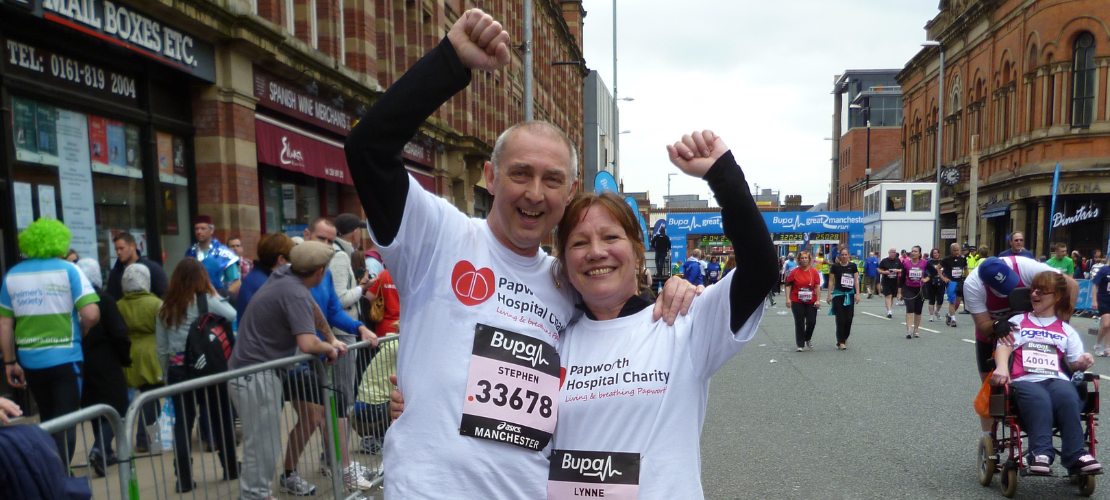
Steve, 71, and his wife Lynne are forever grateful for the rare double lung and heart transplant that saved his life in 2010.
Heart and lung problems
Steve’s lung problems began in 2007 when he noticed a burning sensation in his chest while training for the 10k Great Manchester Run.
He was diagnosed with the incurable condition idiopathic pulmonary fibrosis (IPF). This causes irreversible scarring of the lungs.
Steve needed a transplant but his wait to join the NHS organ transplant list was complicated, partly because he was also diagnosed with cardiomyopathy. This is a type of heart disease which affects the organ’s ability to pump blood around the body.
His condition deteriorated as the anxious wait went on, but in October 2010 a suitable match was found and Steve underwent the double lung and heart transplant.
It is a major and complex surgery performed on average only 9 times a year in the UK due to the scarcity of suitable donors.
However, Steve didn't just survive; he thrived. Just 19 months after surgery he finished what he started by completing the Great Manchester Run - raising money for charity and awareness for organ donation in memory of his 18-year-old donor.
In fact, Steve completed 3 Great Manchester runs in consecutive years and remained very active until shortly before his CLAD diagnosis.
Chronic lung allograft dysfunction, or CLAD, occurs when the body attacks the donor lungs, severely reducing their function. It affects 50% of recipients within 5 years and there is currently no proven treatment.
It all started 2 years ago, he noticed a "dip" in his breathing. "It was always in the back of your mind," said Steve of his CLAD diagnosis.
Taking part in research
16 years after his original transplant, the grandfather-of-two is grateful once again. This time for a trial which has given him a chance of more precious time with his family.
For many lung transplant recipients like Steve, the greatest long-term threat is their own immune system.
He met the criteria for E-CLAD UK which is investigating a potential treatment. He joined the trial at Wythenshawe Hospital, part of Manchester University NHS Foundation Trust.
The trial has had a promising impact on Steve's personal health. One year after finishing the 6-month course of treatment, his condition has stabilised and his consultant is confident his life expectancy can now be thought of in years, instead of months.
"I’ve always been positive, but I do really feel there is positivity, definitely," said Steve.
“It’s not been all plain sailing but it’s [my lung function] still holding and we'll see how we get on. The transplant has given me these extra years, and now it looks like the trial has given me a bit longer. And if it gives me a bit longer, you never know what the future might hold.”
- Steve
The trial
The E-CLAD UK trial is looking at extracorporeal photopheresis (or ECP) - an established therapy, capable of calming the body’s own defence system.
The trial is collecting evidence to assess whether or not ECP can be successfully used to stop, or slow, the damage caused by CLAD and prevent the further deterioration of lung function.
Reflecting on his participation in the trial, Steve, a retired engineer, says it has given his family the priceless ability to plan again.
“I’m very grateful and it's not just me that it's touched - it's my family as well,” said Steve, who can no longer run but still keeps busy by walking, drawing and building model aeroplanes.
“I'm still here with my wife and we have each other. My son is in Australia and he came over last year with his wife and my 2 grandkids and we had a fabulous time together. And the way it's going, we can look at having them over again. It means we can just keep planning ahead like that.”
Visit the Be Part of Research website to learn more about research, search for opportunities and sign up to be contacted about studies that interest you.