

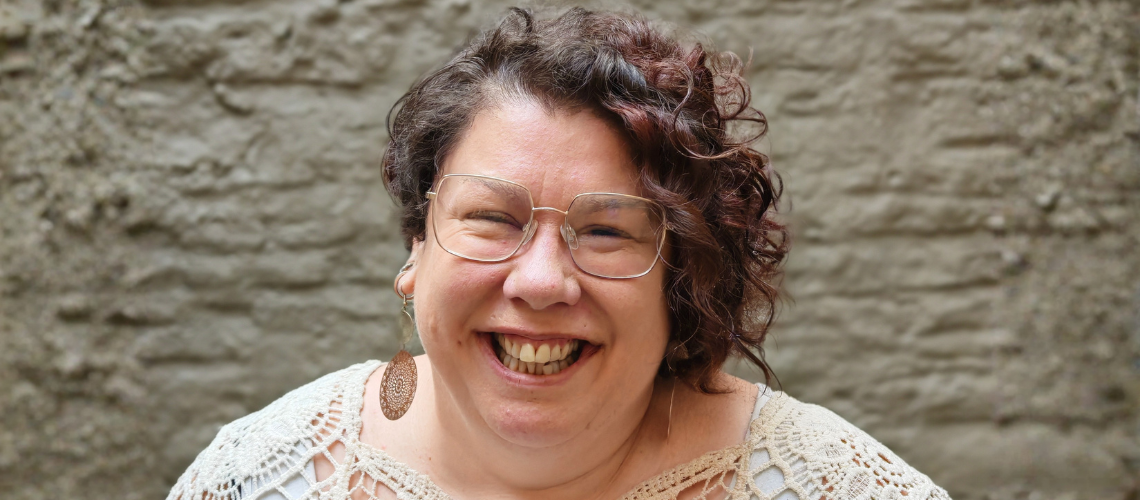
Ingrid, 44, has suffered from hidradenitis suppurativa (HS) for her whole adult life. HS is a painful, long-term skin condition that causes skin abscesses and scarring on the skin.
“Since the age of 19 my life has been punctuated by HS. This is when I had my first operation to drain a painful lump. It resulted in me taking 3 months off university as I had to change my dressings daily and attend nurses appointments.”
Ingrid was formally diagnosed with HS when she was 25, although the full understanding of her diagnosis wasn’t given until she was 30.
“By this point my HS was in several parts of my body, in both under arms, my neck, my groin, both legs and buttocks.
“I had my daughter when I was 29 and the frequency and severity of my HS had increased to a level that was disabling in many different ways. I couldn’t raise my arms or carry much. I was in constant pain when walking, sitting or just generally moving.”
The condition was debilitating for Ingrid physically, socially and emotionally. Lumps would often explode during social events causing Ingrid to hurriedly find a space where she could cover them. Ingrid said: “This would make me really self conscious because of the smell and my ruined clothes."
"I was unable to relax and enjoy social events because of the pain I was in and the fear of people noticing and asking questions."
- Ingrid
“Throughout my experience I came across many health professionals that did not know about HS and with so little known about the condition it was understandable that the emotional impact was often missed as well.”
In 2019, Ingrid signed up to take part in a trial to assess if a drug called secukinumab is safe and has beneficial effects in people who have moderate to severe HS.
“Meeting the team that were working on the trial gave me validation of my experiences. They understood my experiences and heard me.”
“It's impossible to overestimate how important this was emotionally.”
- Ingrid
At the beginning of the trial, Ingrid had weekly appointments in Bristol, an hour away from where she lives in Somerset. Taking part in the trial came with its challenges, as Ingrid explains: “There was a lot of travelling to get to appointments and I had to arrange childcare for my daughter. To be able to take part in the trial, I also had to come off my current medication and painkillers which was really difficult. But going on the trial gave me so much hope. I was determined to do everything I could to have a better life with my condition.”
As the study progressed, the number of appointments decreased to once every 3 months. During the appointments the team checked how many painful lumps or sores Ingrid had. “The frequency of injections has also changed, at first I had an injection every 2 weeks, now I just take an injection once a month.”
Within a short time of being on the trial Ingrid noticed a vast improvement. She went from over 30 active lesions to averaging 1 to 2 lesions a month. “The life of those lesions is much reduced, the pain and inflammation is a lot less and the impact on my life is minimal in comparison to how it was previously.”
“One of the main achievements of being on the trial is being able to retrain and return to work. With my HS improving, so has my body image and my confidence.”
- Ingrid
“Taking part in this trial has been extremely beneficial in improving many aspects of my life.”
How you can get involved with research
Sign up to Be Part of Research to be contacted about a range of health and care research. Or check out our full list of studies to see if one is right for you.
And if taking part in a study doesn’t feel right at the moment there are other ways to get involved in research.